10.4 Structure of MOSU
The model-oriented management system is one of the key results of the digital transformation program and an instrument for achieving its goals. The distinctive feature of this management instrument is the use of calculation results from the integrated CS model when preparing and assessing the efficiency of organizational and technical decisions.
MOSU includes the following components:
a unified indicator system, or coordinate system;
the integrated CS model, where CS means controlled system;
management functions;
a description of the management structure;
management mechanisms.
The indicator system must ensure:
unity in measuring the economic or socio-economic dynamics of the CS state, end-to-end across all analytical slices, subsystems, and supersystems;
consistency and integrity in managing CS behavior, both in the external environment and in managing its internal state.
The functional composition of MOSU includes the following management tasks, though it is not limited to them (see Figure 4):
accounting for and monitoring the CS state;
analysis and planning, including goal-setting, forecasting, identification of bottlenecks, threats, and potentials;
assessment of decisions being made;
confirmation of the quality of decision execution.
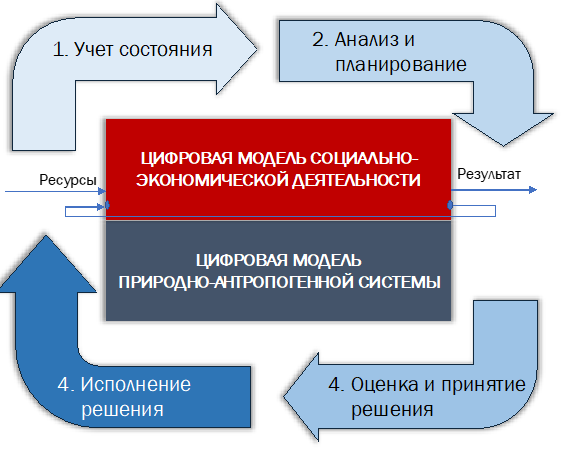
Figure 4. MOSU management functions
Most of the proposed functions are defined by Federal Law No. 172 “On Strategic Planning” of 28 June 2014. The core concepts used by this law are applicable at all levels of management, including the level of individual business entities and economic agents, where justified by the complexity of the controlled system. A significant limitation of this law is the uncertainty of management methods and of the source of techno-economic indicators for coordinating planning decisions.
To eliminate this limitation and ensure management or regulatory integrity, which is especially important at the state level, the concept of an integrated model is introduced. This model makes it possible to store, in a functionally connected form, both source information and consolidated, reporting, analytical, forecast, and planning data on the dynamics of the controlled system.
Another slice of the integrated model helps separate models according to the functional purpose of the CS and the means of production that realize that functional purpose. For state systems, accordingly, the integrated model is considered in the aspects of socio-economic activity (functional purpose) and the natural-anthropogenic system (means of production); see Figure 5.
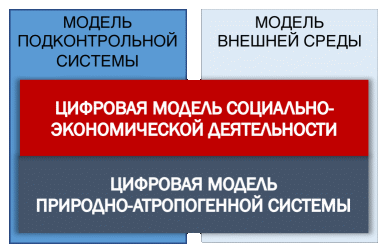
Figure 5. Aspects of the integrated CS model
The natural-anthropogenic system45 has a limited resource and is the means of supporting socio-economic activity. This imposes constraints and sets requirements for allocating part of the result of economic activity to maintaining the proper condition of that system.
In the MOSU context, management structure means the organizational structure of an enterprise, consisting of the corresponding organizational units46 that bear direct responsibility for the dynamics of indicators of individual structural CS components and for the development, adoption, and execution of management decisions.
The composition of management mechanisms can be considered in terms of the following components \[15\]:
improvement and development of the system of regulatory documents;
introduction of new, innovative types of products, materials, equipment, and technologies;
development of the system for training, preparation, and certification of personnel;
development of the methodology for assessing, forecasting, monitoring, managing, regulating, and controlling parameters and indicators;
obtaining, accumulating, and systematizing experimental data on materials, equipment, technologies, and external-environment impact conditions;
integration of information obtained at life-cycle stages of the controlled system in a unified information environment.
A matter of principle in the proposed division of management mechanisms is the distinction between information space and the integrated model. The unified information space is filled primarily with source information coming from data sources whose reliability can be verified47. The integrated model, in turn, solves the tasks of analysis, enrichment, high-level processing, and interpretation of a wide range of data above the information space.
The information space must:
implement the collection, storage, associative linking, and presentation of blocks of source and calculated information about the CS and the external environment;
ensure construction of ordered associative structures of different kinds, such as sets, ordered sets, graphs, directed graphs, and so on;
rapidly build specialized selections and views through associative structures;
provide the possibility of functionally linking source data in the unified information space with calculated values of indicators and parameters of the integrated model;
contain standard solutions for regularly recurring tasks;
contain standard solution methods for irregular tasks.
The MOSU concept does not address the management of teams or interpersonal relations. It is limited to the task of quantitatively grounded management of the CS state and the gradual reduction of the negative influence of the human factor on target-activity results. It should be noted that the formation of management goals and the adoption of non-standard decisions remain the prerogative of people; the role of MOSU is only to form grounded programs for achieving the stated goals.
MOSU does not replace, but significantly expands, the concept of automated management systems. It focuses the attention of designers and architects of management systems on the justified choice of useful automation contours: the solution of priority social, economic, technical-technological, and natural-anthropogenic problems.
The absence of economic success from the introduction of automated management systems is due primarily to a focus on automating routine operations, which do not always even increase labor productivity, let alone other aspects of efficiency. The share of routine labor in knowledge-intensive and capital-intensive sectors, both the new and old economies, is currently extremely small and does not create meaningful potential for economic actors to realize competitive advantages.
MOSU supports a gradual transition from bureaucratic and intuitive principles of CS management, implemented through the mechanism of assignments and trust-based delegation of authority from higher management, to plan-program mechanisms quantitatively grounded by calculations on the integrated CS model.