10.2 Goals, Objectives, and Structure of the Model-Oriented Management System
“The fashion for automated enterprise management systems that emerged among industrial managers in the 1960s led many enterprises to hurry to acquire electronic computers, build their own computing centers, and create automated management systems. Not everyone, however, understood the real complexity of the matter. When serious difficulties began to be felt in practice, they had to limit themselves to partial automation of document flow, accounting, and a few other secondary management functions. It is quite clear that such automated management systems could not produce the expected economic effect.
Specialists have long concluded that an automated enterprise management system will be genuinely effective only when, alongside fast and accurate machine processing of the most detailed information, many new management tasks, mainly optimization tasks, are solved at the enterprise through the use of modern economic-mathematical methods and computers”\[14\].
The purpose of implementing the digital transformation doctrine (hereinafter, the Doctrine) is to increase the effectiveness and efficiency of resource use across the entire structure of international, national, regional, and corporate economic activity, its individual functions5, the life-cycle stages of infrastructure objects, and management mechanisms (hereinafter treated as analytical slices).
For the Doctrine, it is essential to define the boundaries and interconnections between the managed object and the external world. For this purpose, the basic concept used is the
CONTROLLED SYSTEM (CS)
– a complex that carries out economic or socio-economic activity to satisfy consumers of products (resources, goods, works, and services) that have been produced, transported, accumulated, or distributed with specified quality parameters. Each CS must be considered as part of another controlled system and must consist of separate controlled systems40.
The instrument for achieving the purpose of the Doctrine is the
MODEL-ORIENTED MANAGEMENT SYSTEM (MOSU),
which enables decision-makers to allocate their efforts
and resources on the basis of quantitatively measurable assessments
of the consequences of action or inaction by economic actors.
Quantitative assessments of results and costs are the input
and output characteristics of a continuously operating and continuously
refined
INTEGRATED CS MODEL
The integrated CS model links the dynamics of measured indicators41 to potentially regulable CS parameters and to the dynamics of the CS’s two-way interaction with its external environment42 across its full structure. In some sources, the integrated CS model is referred to as a digital twin.
The integrity of CS management functions is guaranteed by the
UNIFIED CS DEVELOPMENT PROGRAM,
which quantitatively43 links the goals, objectives, measures, activities, and individual projects of current and planned management impact on the CS. The unified development program is an instrument of long-, medium-, and short-term planning and a source and instrument for prioritizing organizational and technical measures for state, investment, and production programs, including projects for forming and improving the MOSU itself.
A conceptual diagram of the MOSU context is shown in Figure 3.
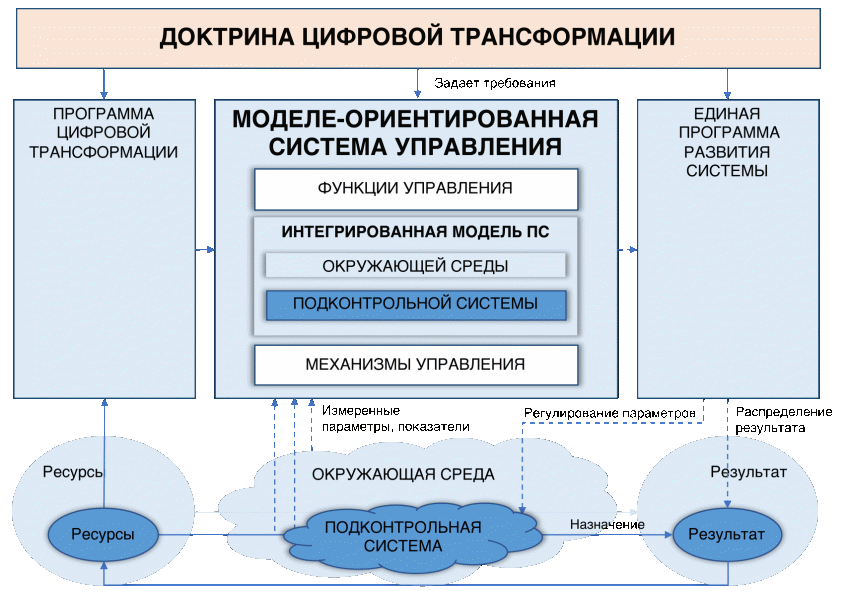
Figure 3. Conceptual diagram of MOSU
By analogy with the concept of “functional block” in the IDEF0 modeling language.↩︎
Results and costs.↩︎
In a broad interpretation: socio-economic systems, the natural-anthropogenic environment, adjacent technological processes, and actors.↩︎
Here and below, a “quantitative” link means a computable link that has a numerical or digital assessment.↩︎