6.2 Basic approach
The main approach is that the quantitative assessment fulfilled on a system model has to be the basis for management (policy) decisions.

Basic Concepts of the Model-Based Management theory
The Digital Twin, as a system of indicators, links the dynamics of basic (measured) and target indicators with a system of equations in time, life cycle, space, and industries.
The Digital Twin is built on a top-down approach. From a compact system of goals determined by the development strategy of the whole territory to individual areas and business activities, municipalities, settlements, and individual objects and entities located/settled on the territory.
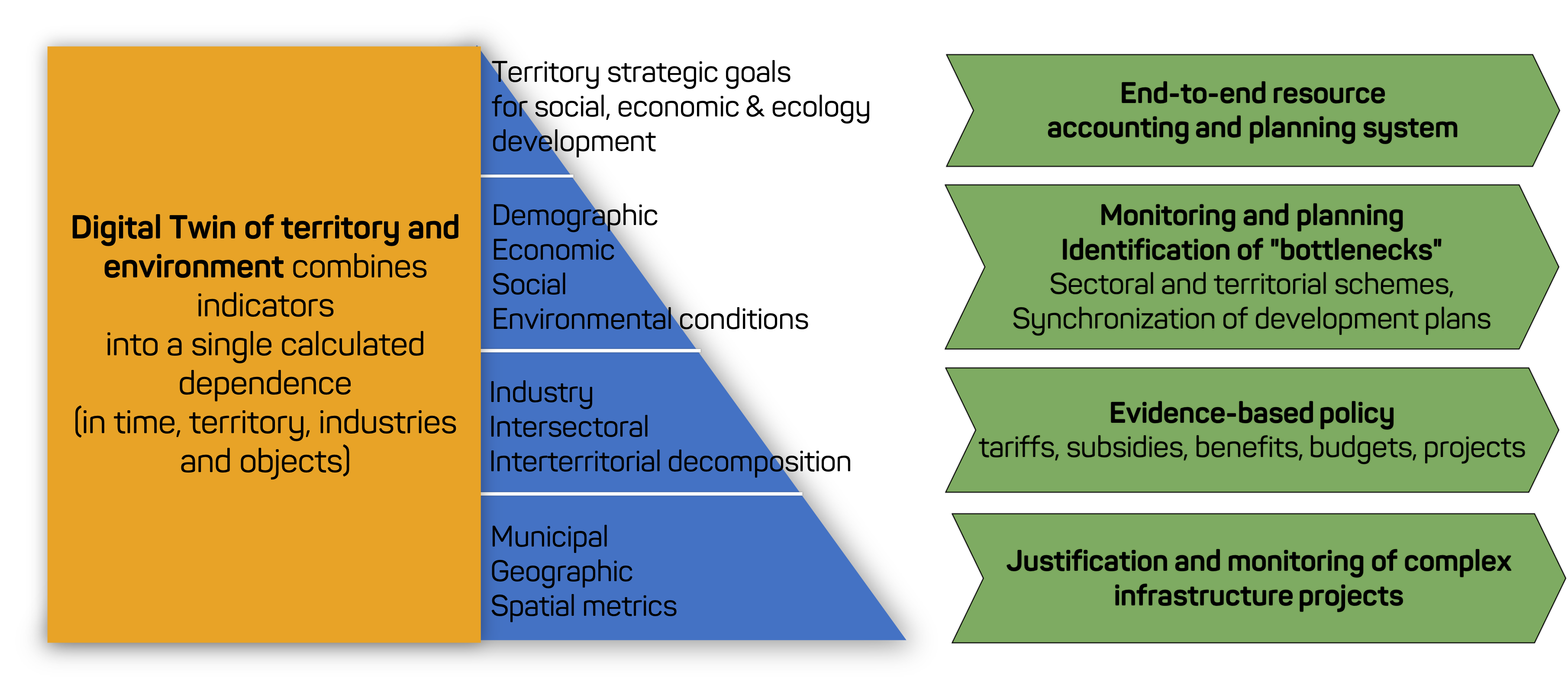 Actual, predictive, and planned values of indicators estimated by City Digital Twin ensure the integrity of the parameters of management decisions and are implemented through standard territorial management mechanisms, including strategic planning documents.
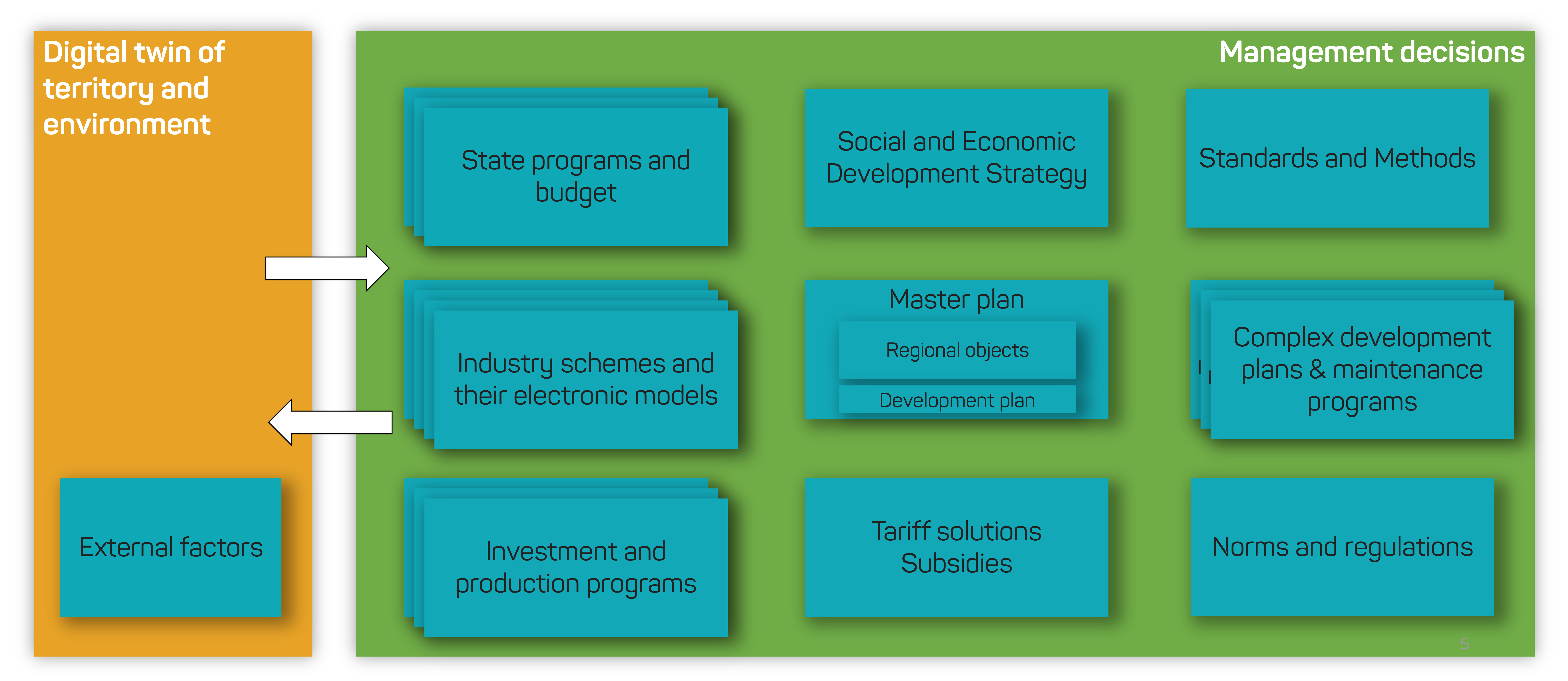
Territory Management Implementation Mechanisms Using Digital Twin Estimation Results
The description of Digital Twin is carried out in the following functional modules and data segments (measurements):
- Module 1. Socio-economic development, covering macroeconomic indicators of the development of the territory
- Module 2. Intersectoral balance of resources, ensuring the integrity of accounting for the movement of resources in the economy between different types of economic activity
- Module 3. Interterritorial balance of resources, ensuring the spatial integrity of accounting for the movement of resources between municipalities and settlements
- Module 4. Intra-industry balances, providing intra-industry accounting within one type of economic activity
- Module 5. The life cycle of infrastructure, ensuring the integrity of the description of the state of the infrastructure of the life activity of the territory
- Module 6. Natural-anthropogenic systems that describe the mutual influence of the socio-economic and ecological state of the territory
- Dimension 1: Spatial data segments from the city as a whole to a unified element of infrastructure
- Dimension 2: Analysis of data segments by time (state decomposition in time)
- Dimension 3: Structural-functional analysis data segments
- Dimension 4: Analysis of data segments by logistics

Functional and Structural Decomposition of the City Digital Twin