10.1 Digitalization and the Problems of the Economy
It may be assumed that social and economic relations should be described by laws analogous to the laws of physics. The golden age of physics and its comprehensive application in engineering was the twentieth century. The prosperity of socio-economic relations should be the focus of leading minds in the current century. That prosperity will be linked to the introduction of high-precision physical-mathematical and engineering methods into management. Otherwise, society will face intellectual degradation, escalating conflicts, and a growing number of anthropogenic disasters.
A negative feature of the current state of society is the high inertia of developing and making important decisions, a weak ability to analyze and prevent errors, and a focus on short-term gains.
At the same time, decisions in society and the economy are developed and made by specific actors. Many of these decisions are based on their private interests and do not take account of the consequences for society and its surrounding environment. The problem is not only subjective self-interest, but also an underestimation of the closed and internally connected nature of the system around us, which guarantees feedback: the “boomerang” of consequences from inadequate decisions.
The absence of practical methods and ready-to-use tools for a comprehensive assessment of the consequences of decisions, including the dynamics of the external environment of the stakeholder, reduces the rationality and effectiveness of public, economic, and corporate relations.
New generations of social actors spend resources trying, after rejecting the accumulated knowledge of their predecessors, to prove their superiority and seize the right to dispose of public goods. This race produces new terms for old subjects, and new goods and services that shift consumer attention away from urgent tasks toward fictitious ones. Such a negativist strategy cannot produce the sustainable outcome whose theoretical basis has already been accepted by specialists \[1\].
The world of high technology, which has concentrated many of the planet’s smartest people in Silicon Valley, is increasing its capital at a tremendous pace: 177% over the last six years (see Table 1). The range of products and services offered by these powerful corporations does not solve society’s basic problems \[2\], but it reduces the opportunities for scientific and technological development in traditional sectors of the economy. Over the same six-year period, the average annual Dow Jones Industrial Average, which consolidates companies that are basic to the U.S. economy, grew by only 60%, from 13,000 to 20,815 points \[3\].

Table 1. Capitalization growth rates \[4\]
Transnational corporations headquartered mainly in the United States, the data for which are shown in the statistical table, define key technology development trends for the entire world. But how can one stimulate the development of the economy as a whole, balancing not only corporate interests but also the interests of the least consolidated sector of the economy: households? After all, the welfare of the population is both the source and the purpose of economic prosperity.
There are clear imbalances between the growth rates of:
the new and old sectors of the economy;
the corporate and consumer domains;
developed and developing countries.
These imbalances create prerequisites both for socio-economic crises and for new development potential.
One notable actor in the technology market that identified opportunities to improve the rational use of resources for realizing economic potential in the traditional, capital-intensive economy was IBM, which announced the Smarter Planet initiative in 2008. The key idea of that campaign was the adaptation of new-economy technologies to solve the problems of the traditional economy. Bright and attractive slogans appeared: “Digital Oil Field”, “Smart City”, “Smart manufacturing”, and so on36.
The marketing initiative acquired followers among technology-solution vendors and consulting firms \[5\]. In 2014-2015 new slogans were added: Big Data, Machine Learning, Artificial Intelligence, Blockchain, the Internet of Things, Digital Twin, and others. On this wave, the slogans “Digital Economy” and “Smart City” were officially adopted in Russian society in 2017, supported by state and quasi-state37 funding of 3.5 trillion rubles \[6\].
Despite the hype around such technocratic ideas, over the past ten years no unified ideology or technological platform has been developed. Producers of equipment and technologies have not been able to demonstrate substantial economic breakthroughs in the traditional economy.
Traditional-economy actors partly support the “warming up” of the technology market, especially in sectors that accumulate capital because of favorable market or state conditions. For example, PJSC Rosseti, a state-owned company and natural monopoly in the Russian electricity transmission market, announced an investment program of 1.7 trillion rubles through 2030 \[7\]. At the same time, electricity prices for consumers are rising and will probably continue to rise, mainly due to the electricity transmission tariff, at rates exceeding GRP growth and household income growth.
Oil-producing companies, with their Digital Oil Field initiatives, are also key sponsors of projects intended to put the new economy at the service of the old economy, although such projects have so far been unsuccessful in that respect. Quite often, projects such as Digital Oil Field are driven by political motives rather than by the need to achieve meaningful economic outcomes for an enterprise or a region. Despite steady revenue growth in the oil and gas sector, Russian hydrocarbon companies demonstrate a decline in the economic efficiency of their operations and an increased burden on the economy of their consumers. Figure 1 shows the dynamics of aggregate economic-efficiency indicators for two vertically integrated oil and gas corporations that are key to the Russian economy: the state company PJSC Gazprom and the private company PJSC Lukoil.
The cost of selling extracted and processed oil grows more expensive year after year (thick solid line), as does the cost of its production (thick dashed line). Both lines show that cost growth rates exceed not only inflation but also the growth of the Russian Federation’s gross national product. One component of operating costs, expenses for restoring fixed assets, is growing faster than the others, signaling the low efficiency of capital investment in particular: the very driver that, under other conditions, should support economic growth.
Figure 1. Cost growth rates and efficiency decline
of Russian oil and gas companies relative to the 2010 level
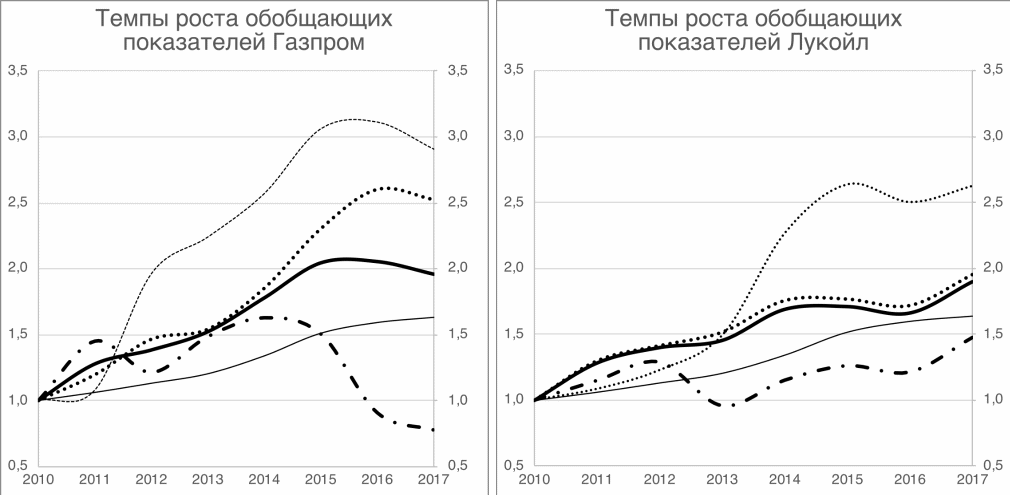
The lines in Figure 1 reflect growth rates relative to the 2010 level for the following indicators:
thick dashed line: operating expenses per unit of extracted product, including expenses for maintaining and restoring fixed assets;
thin dashed line: fixed-asset restoration expenses;
thick solid line: the consumer price per unit of extracted product;
dash-dot line: the ratio of gross profit to production volumes;
thin solid line: inflation dynamics, measured by consumer prices.
The main contribution to product-cost growth is made by the declining efficiency of capital investment, mainly investment in maintaining the existing asset infrastructure. Although the cost-growth trend is linked to depletion of proven hydrocarbon reserves (according to the Analytical Center for the Government of the Russian Federation, 2018), it is worth noting the opposite trend in the United States: a decline in the cost of shale oil and gas production under more complex geological conditions.
These charts indicate a decline in the economic efficiency of the main sectors of the Russian economy, an increased burden of the fuel and energy sector on gross regional product, higher energy intensity of GRP, and a deterioration in the population’s quality of life. This fact also confirms the absence of significant scientific and technological breakthroughs in sectoral science and production. At the same time, it forms target benchmarks for possible efforts by managers who associate growth potential with more precise digital management technologies.
The opposite situation can be observed in the U.S. economy. The use of new, predominantly digital technologies in the development and extraction of raw materials reduces average production cost from USD 70 per barrel in 2013 to USD 30 per barrel in 2016 (NA ShellWellCube, 2016), increases competitiveness, and consequently raises hydrocarbon production from 2.3 to 11 million barrels per day (Rossiyskaya Gazeta, 2018).
Cost reduction and competitiveness growth in markets are possible only through the targeted development and involvement of the new economy in solving techno-economic problems and challenges.
Source: company annual reports
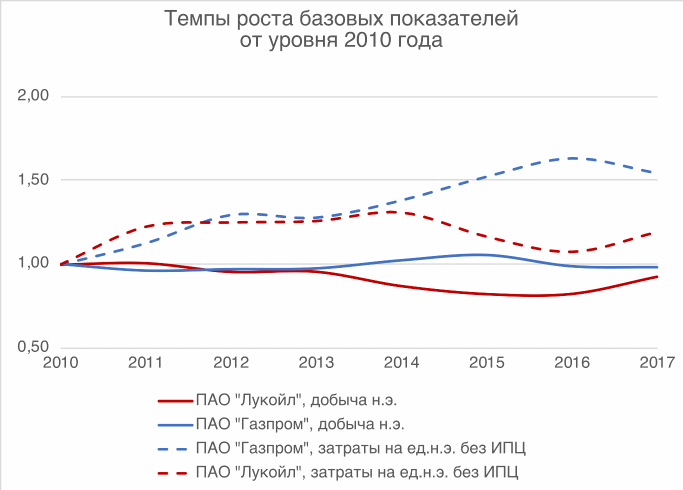
Figure 2. Dynamics of baseline production-volume and unit-cost indicators for the largest Russian oil and gas companies
Figure 2 shows the observed dynamics of production volumes and costs among the largest Russian oil and gas companies. Production volumes grow rather weakly against the background of confident growth in product costs38. Judging by the dynamics of economic outcomes, development projects of Russian hydrocarbon companies, including digitalization projects, have not yet had a significant impact on the economics of these enterprises.
If we move from the national economy to the regional level, accumulated inefficiency is also growing in basic domains of economic activity such as municipal infrastructure and energy systems, and passenger transport \[8\].
In particular, a comprehensive assessment of the techno-economic dynamics of municipal infrastructure, energy, and transport-support systems reveals the following problems:
Disproportions in the growth of tariffs and product costs across territories, sectors, and economic entities.
Declining efficiency of capital investment in the development of economic activity and the technical condition of fixed assets.
Inconsistency between statistical, forecast, and planning data needed to study intersectoral or interterritorial consequences of state and corporate regulation.
It is obvious that the lack of a unified system of intersectoral accounting and optimal planning does not allow economic growth to accelerate, increases the economic burden, and reduces the population’s quality of life.
The main conclusions from the facts and judgments above are as follows.
International, predominantly American, new-economy companies are winning the competition for capital against the traditional economy. The key instrument that produces this outcome is the involvement of intellectual resources, or human capital, in economic activity.
Despite the international hype around digitalization technologies, it has not been possible to find studies demonstrating the efficiency of these technologies’ contribution to the economic growth rates of the traditional economy.
Specific progress in applying digital technologies in the traditional sector is shown by U.S. shale oil and gas production, which moved from laggard status to international leadership \[9\]. This success became possible due to proprietary scientific and technological developments that enabled companies to reduce the cost of field development and operation. This experience can partly be attributed to success in proprietary technology development with substantial digital support.
The Russian oil and gas industry has not yet demonstrated its own competitive technology stack, and therefore its economic performance is under increasing pressure in the international market.
- The Russian economy, represented by its basic sectors, is reducing its economic efficiency and international competitiveness while increasing the burden on Russian consumers through the cost of fuel \[10\] and fuel-derived products \[11\].
In the first cycle, the increased burden on consumers reduces real household income \[12\]; in the second cycle, it leads to lower economic growth rates and increased dependence of the economy on hydrocarbon exports \[13\].
Corporations that are key to the Russian economy currently face difficulties in their own scientific and technological development because of the high profitability of current operations, the absence of positive experience, and a lack of incentives for effective work on developing intellectual capital.
- Investments in the digitalization of the traditional economy are useful only on a recoverable basis.
The result of such investments must be growth in the economic efficiency of traditional sectors of the economy: fuel and energy, housing and utilities, transport, and construction. The quantitatively substantiated part of this result must be directed to forming sources of finance for the new sector of the economy: sectoral science and engineering, which develops economically viable technologies.
- Stimulating the development of the new economy in the Russian Federation is linked to implementing a new state and public policy aimed at economic-efficiency growth.
Such a policy can be implemented only by improving and consolidating a unified system for managing socio-economic development at all levels of the state and public structure: a transition from subjective management to rationally grounded digital management.
Defining directions for developing methods of quantitative management of socio-economic development39, improving corporate management systems, and ensuring a balance between the interests of enterprise shareholders, consumers, and society formed the basis for creating the concept of a model-oriented management system (MOSU) and the digital transformation doctrine.
A distinctive feature of new economic-management models, including at the state level, must be the priority of results over costs: that is, efficiency in the economic sense. Management models must provide a quantitatively precise link between results and resource-allocation methods across the structure of economic activity, taking account of multiplicative effects and feedback loops.
The formation of the Digital Economy and Smart Cities should not depend on a set of technological solutions for isolated economic problems. The task of the digital economy is to cover the behavior of the socio-economic system and its environment with a holistic quantitative description, and to increase management capability in identifying, preventing, and eliminating bottlenecks that constrain efficiency growth. This approach will make it possible to formulate long-term objectives not only for socio-economic and infrastructure development, but also for scientific and technological development.
The most precise and resource-grounded formulation of long-term goals and objectives for socio-economic development can form a new, sustainable sector of the knowledge economy.
The task of the next chapter is to formulate several theses of the digital transformation doctrine and the concept of a model-oriented management system for the traditional economy, whose creation is driven by the need to:
reduce disproportions in socio-economic development;
identify bottlenecks that reduce the sustainability of socio-economic development;
increase the effectiveness of corporate, state, and interstate decisions;
transfer the achievements of the new economy into the traditional economy.
It should be noted that IBM was unable to transform this initiative into technological and economic success. From 2012 to 2018, its revenue fell by 23%, as did the revenue of other technology giants that once built capital on computer-hardware production: Hewlett-Packard, down 53%, and Cisco, whose revenue stagnated at level 1%.↩︎
At the expense of corporations with predominantly state ownership.↩︎
Adjusted for actual inflation.↩︎
Without increasing state participation in the capital of the economy.↩︎