10.5 Integrated CS Model
Creating MOSU is similar to the transition in software engineering from procedural programming to the object-oriented paradigm. The object in the MOSU context is the CS, or controlled system, and the environment external to it; the object’s description is the integrated CS model. Today, integrated models are often called digital twins, with the concept including the ability to accumulate knowledge about the CS and perform scenario calculations of CS state dynamics before a decision is made.
An integrated model is a computational and analytical instrument that enables a reliable quantitative assessment, taking account of the accuracy of the model under consideration, of:
dynamics of the actual and forecast CS state;
deviations of the actual state from expected values;
the magnitude and point of application of forces that influenced the dynamics of the actual CS state;
consequences of inaction and of implementing decisions;
economic development potential and its maximum admissible costs;
parameters of newly created or modernized CSs with a new level of effectiveness and efficiency.

Figure 7. Diagram of the mathematical description of the integrated model
The indicator system in which CS behavior in the external environment is mathematically described below includes the following groups:
techno-economic indicators;
aggregate indicators;
relative coefficients or CS parameters (P).
The distinctive features of techno-economic indicators are their
measurability and the possibility of direct regulation.
CS techno-economic indicators include:
CS productivity or output capacity (installed and available, Q*; actual, Q), with a specified result quality*;
resources consumed to provide productivity (Y);
damages to the external environment: social, environmental, and techno-economic damages (U).
Techno-economic indicators may be represented in physical, value, and energy terms, as a group or vector of products, and always have a unique unit of measurement for each product type.
Techno-economic indicators are the basis for defining aggregate indicators of CS state dynamics:
| Indicator | Calculation method |
|---|---|
| Reliability 48 | \[R = \frac{Q^{actual}}{Q^{planned}}\] |
| Safety | \[S = \frac{U^{allowable}}{U^{actual}}\] |
| Efficiency | \[E = \frac{(U + Y)}{Q}\] |
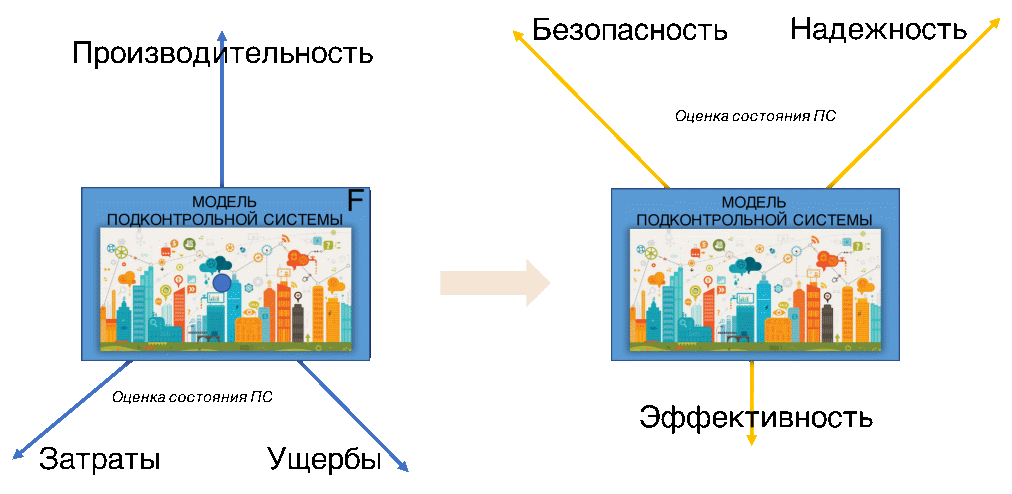
Figure 8. Coordinate system of the CS state
in techno-economic and aggregate indicators
Aggregate indicators are the main indicators for managing CS development, but they are not available for direct measurement and intervention. Improving management accuracy is linked to targeted growth of aggregate indicators and to defining and continuously refining the mathematical description of the integrated model:
\(V = F(Q,Y,\ U,t)\) - description of the effectiveness of CS behavior, (1)
\(G\ (F(P,\ Y,t)) = \max < R,S,E > \ \) - description of the CS management function (2)
By the types of values they take, indicators are divided into retrospective, actual, forecast or inertial, scenario, and planned indicators.
As deviations of CS behavior from target or planned indicators, or from forecast or inertial indicators, are identified and ranked, the CS function is refined and detailed by possible analytical slices.
Decomposition or aggregation of functions, with determination of the function type and its parameters, proceeds as design and statistical data on CS state dynamics over the actual time period are processed. The procedure for gradually determining quantitative and qualitative characteristics of the CS function and decomposing it by analytical slices from the top down makes it possible to preserve the integrity of the integrated model description and avoid problems of reverse integration of the functions of individual CS components into a single whole.
In general form, the mathematical description of CS state dynamics can be written as follows:
\(\mathrm{\Delta}V = \frac{\partial F}{\partial P}\mathrm{\Delta}P + \ \frac{\partial F}{\partial Y}\mathrm{\Delta}Y + \ \frac{\partial F}{\partial t}\mathrm{\Delta}t\), (3) where
\(\frac{\partial F}{\partial P}\mathrm{\Delta}P\) is the change in CS parameters resulting from organizational and technical measures, most often included in investment programs;
\(\frac{\partial F}{\partial Y}\mathrm{\Delta}Y\) is the increase in resource-use efficiency, implemented through investment programs;
\(\frac{\partial F}{\partial t}\mathrm{\Delta}t\) is the change in the CS state over time, including as a result of system wear and restoration.
The mathematical description must be sufficient to provide the user with calculations of retrospective values, including restoration of missing indicator values; actual values; forecast values; scenario values, given the occurrence of specified events or measures; and planned values.
The proposed indicator system and mathematical description of the integrated model form requirements for CS information modeling. Among the most promising implementation options are information-modeling and ontology-modeling methods and technologies, which are considered in other chapters of this monograph.
The information model must ensure the integrity of calculations based on the mathematical model. Among other things, it is responsible for collecting, integrating, storing, and providing data for the formation and assessment of organizational and technical decisions. A variant of the scheme linking the mathematical and information descriptions of the integrated model with the computational and analytical complex is shown in Figure 9.
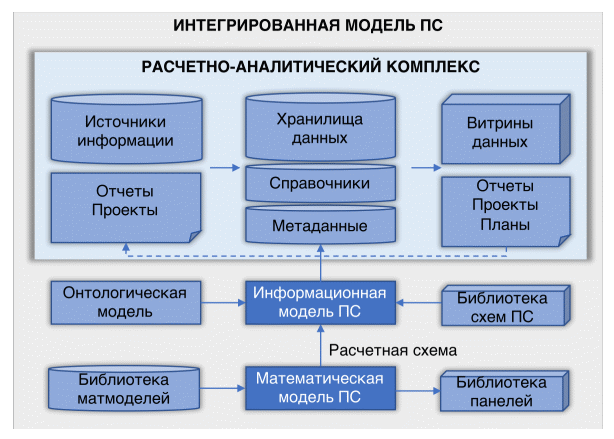
Figure 9. Variant scheme of relationships among components of the integrated model
Reliability of fulfilling the target purpose, namely output production, with predefined qualitative characteristics.↩︎