3.5 Experience of cities in building Digital Twins
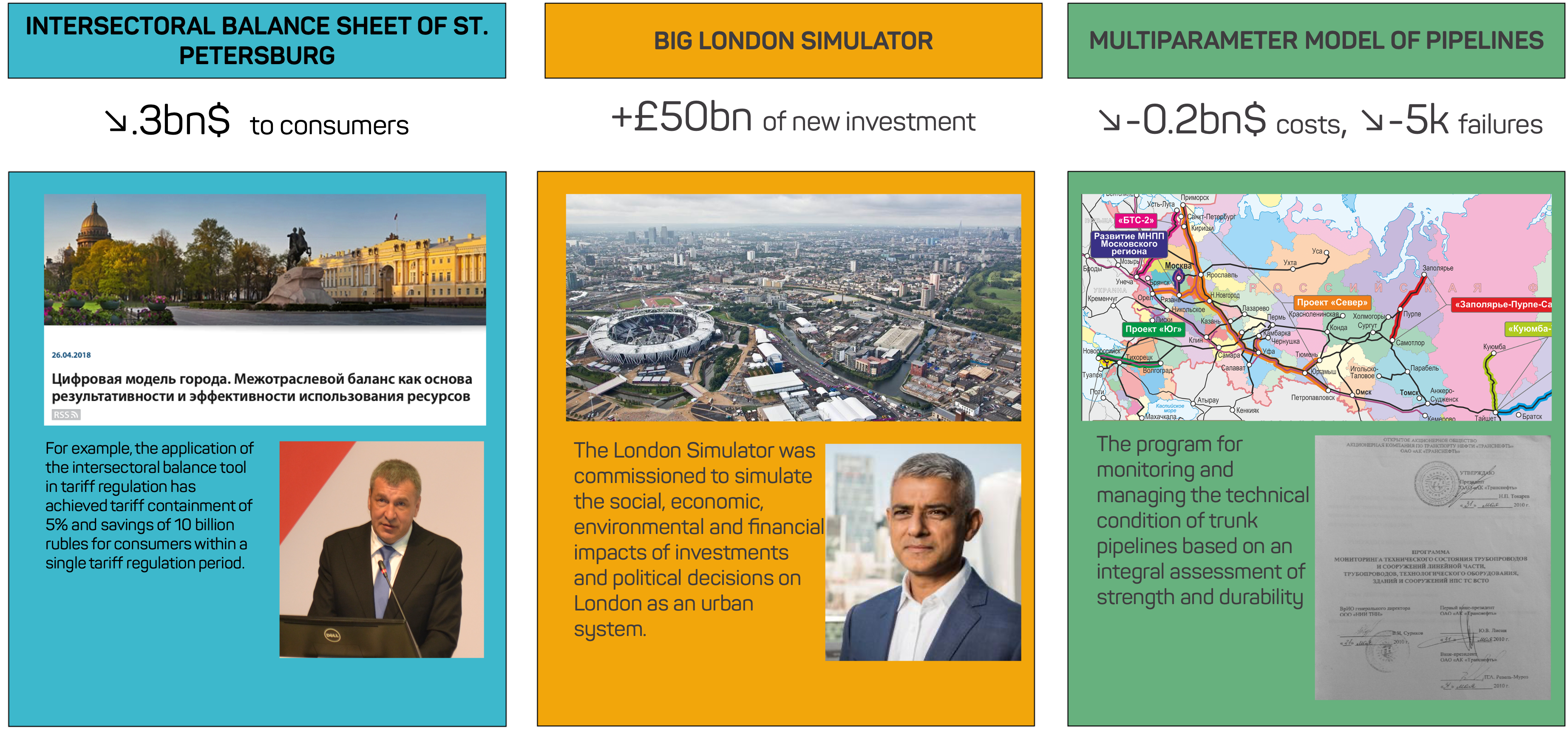
Examples of digital twins of complex systems
3.5.1 Intersectoral balance of St. Petersburg
St. Petersburg is the first city in Russia that has developed and applied a model for the intersectoral balance of resources (a prototype of the City Digital Twin) to support management decision-making in the areas of communal infrastructure, energy, and public transport.
Links to the results of its application:
- results of the application of intersectoral balance by the state executive authorities,
- report from the region’s vice-governor on the results of the application,
- unified information system.
The model of intersectoral balance played a major role in the formation and implementation of the following applications in tariff and sectoral regulation:
- intrasectoral balance of resources of the municipal infrastructure and energy system of St. Petersburg. The methodology can be found in “Bulletin of the Tariff Committee” on page 10
- transport and economic balance of St. Petersburg
The intersectoral balance model is based on a system of indicators interconnected by an economic and mathematical model that characterizes the balance of resources (resource requirements and economic interests) of related economic activities in terms of volume and value.
The system of indicators of the decision support tool consists of the following groups:
- targets - indicators of reliability, availability, safety, economic and energy efficiency
- basic technical and economic indicators, reflecting the volumes of consumption and production, output and costs, capacity and load, assets and liabilities, income and payments
- correlation coefficients, allowing for forecasts and analysis of the financial and economic activities of enterprises
The initial data for the intersectoral balance are:
- population forecast
- volumes of specific consumption of resources
- production volumes, capacities and load volumes, and the volume of losses
- costs and capital investments
3.5.2 London Simulator
The Greater London Simulator is a project implemented by the consulting company Greenwood (Switzerland) and ordered by the London administration. It was designed to conduct scenario-based assessments of the socio-economic effects of the implementation of large investment projects.
A report describing the results of the project “Fill the Gap” shows new funding and investment financing mechanisms for cities in the 21st century.
3.5.3 Infrastructure & pipeline Digital Twin
Questions & proposals
All rights reserved Digital twin LLC