3.4 A model-based management system
The concept of a Model-Based Control System (MBCS) is the methodological basis for involving Digital Twins in the management decision-making process. This approach is detailed in the Model-Based Control System Manifesto (Appendix).
The essence of the approach is that quantitative assessment performed on a system model should be the basis for management (policy) decisions. Key principles of MBCS:
- Measurability — management decisions should be based on quantitatively measurable indicators for which statistical observations or direct measurements are possible;
- Modelability — indicators should be linked by a system of equations describing the life cycle of managed objects in time, space, and industries;
- Traceability — from source data to final results, complete traceability of transformations must be ensured;
- Scenario approach — decisions should be evaluated in “what if” and “what is needed to” variants, accounting for external factors and constraints.
The Digital Twin, as a system of indicators, connects the dynamics of basic (measured) and target indicators through a system of equations in time, life cycle, space, and industries, providing a unified information environment for all participants in the territorial development management process.
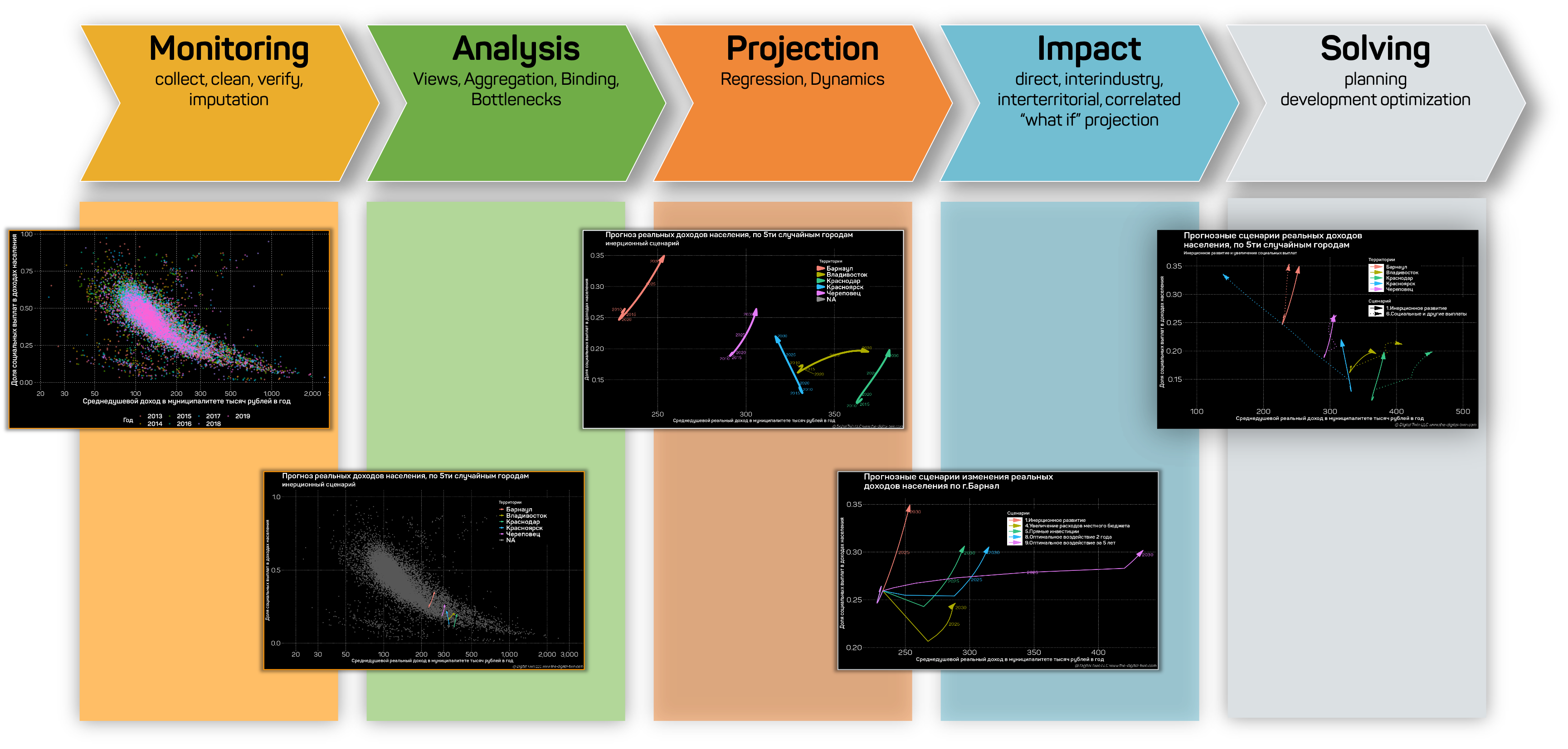
The key functions of this management decision support system are shown in the scheme: